

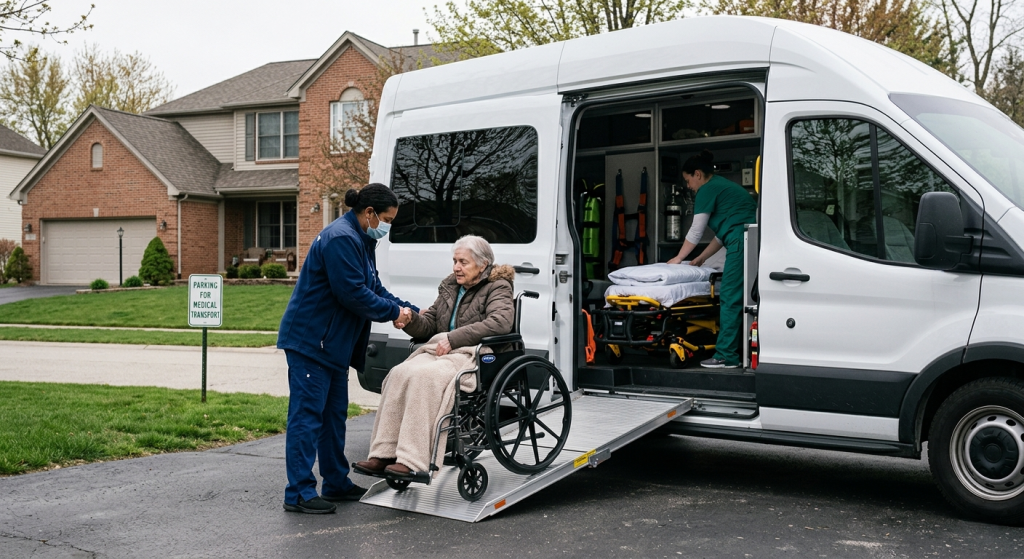
When a family member can no longer comfortably travel in a regular car, one of the first questions families often face is whether to arrange wheelchair or stretcher transportation.
The answer is not simply based on age, diagnosis, or how far the patient is traveling.
The most important factor is how the passenger can safely and comfortably remain positioned during the trip.
A person who can remain seated but has difficulty walking or transferring may be better suited for wheelchair transportation. A medically stable patient who cannot tolerate a seated position may need stretcher transportation instead.
For families across Manassas, Fairfax, Woodbridge, Springfield, Annandale, Tysons, McLean, Reston, Herndon, Arlington, Alexandria, and other Northern Virginia communities, understanding the difference before booking can help avoid last-minute problems.
Safe Medical Transport provides private-pay Non-Emergency Medical Transportation (NEMT), including wheelchair, stretcher, bariatric, hospital discharge, stair-assistance, and long-distance transportation.
What Is the Main Difference Between Wheelchair and Stretcher Transportation?
The simplest difference is the passenger’s traveling position.
Wheelchair transportation is generally appropriate when the passenger can remain comfortably seated in a wheelchair for the journey.
Stretcher transportation may be appropriate when a medically stable passenger cannot comfortably remain seated and needs to travel lying down.
Both services fall under non-emergency transportation when the passenger does not require emergency medical intervention during the trip.
This distinction matters.
Someone who uses a wheelchair at home does not automatically need a stretcher. At the same time, someone who normally uses a wheelchair may temporarily need stretcher transportation after surgery, hospitalization, injury, or a significant change in mobility.
The transportation decision should therefore reflect the patient’s condition on the day of travel.
When Is Wheelchair Transportation Usually the Better Option?
Wheelchair transportation may be suitable when the passenger:
Can remain seated throughout the trip
Uses a wheelchair for everyday mobility
Has difficulty walking longer distances
Cannot easily transfer into a regular passenger vehicle
Has reduced balance or lower-body strength
Is recovering from an illness or procedure
Needs transportation to recurring appointments
Is being discharged but can travel seated
Requires a standard or bariatric wheelchair
Needs transportation to rehabilitation or another care facility
For example, an older adult living in Manassas may use a wheelchair but comfortably remain upright during a trip to Fairfax.
A resident of Springfield may need wheelchair transportation for rehabilitation in Falls Church.
Someone in Reston or Herndon may need a wheelchair-accessible ride for regular specialist appointments in Fairfax.
In these situations, a stretcher may provide more assistance than the passenger actually needs.
When Might Stretcher Transportation Be More Appropriate?
Stretcher transportation is different.
It may be considered when a medically stable passenger is unable to comfortably maintain a seated position for the journey.
This could include someone who:
Must remain lying down
Cannot tolerate prolonged sitting
Has significantly reduced mobility after hospitalization
Is being discharged following certain procedures
Cannot safely transfer into a wheelchair
Needs transportation between medical or care facilities
Requires a longer non-emergency trip while lying down
Has mobility limitations that make seated transportation impractical
For example, a patient may be discharged from a hospital in Falls Church and need to return home to Woodbridge while remaining in a stretcher position.
Another passenger may need transportation from a rehabilitation facility in Fairfax to a medical appointment in Arlington.
Stretcher transportation is still non-emergency transportation.
If a person is experiencing a medical emergency, is medically unstable, or requires emergency treatment during transportation, emergency medical services should be used instead.
A Simple Wheelchair vs. Stretcher Comparison
For families who are unsure, think about the passenger this way:
Wheelchair transportation may be appropriate when:
The passenger can sit upright comfortably.
The passenger already uses a wheelchair.
The main problem is walking, transferring, balance, or entering a regular vehicle.
The passenger is medically stable and does not need to remain lying down.
Stretcher transportation may be appropriate when:
The passenger cannot tolerate a seated position.
The patient needs to remain lying down for the journey.
Transferring into a wheelchair is not practical.
The patient’s current mobility after hospitalization or treatment makes seated transportation unsuitable.
This is why describing the passenger’s mobility is more helpful than simply saying, “We need medical transportation.”
Why This Decision Is Important for Older Adults
Mobility can change gradually with age or suddenly after an illness, fall, surgery, or hospital stay.
Fairfax County alone had an estimated 1,167,873 residents in 2025, with 16.2% age 65 or older, according to the U.S. Census Bureau.
Falls are also an important consideration when discussing older-adult mobility. The CDC reports that more than 14 million adults age 65 and older—about one in four—report falling each year, and falls remain the leading cause of injury among this age group.
This does not mean that every senior needs NEMT.
It does mean that families should take changes in strength, balance, transfers, and mobility seriously when planning transportation.
An older adult who previously traveled in a regular car may need a wheelchair temporarily after hospitalization. Another patient who normally uses a wheelchair may temporarily require a stretcher.
The best transportation choice is based on the passenger’s current needs, not what they used six months ago.
Wheelchair vs. Stretcher Transportation After Hospital Discharge
Hospital discharge is one of the most common times families need to make this decision.
A patient may have arrived at the hospital walking independently but leave with much less mobility.
Before discharge, ask:
Can the patient sit upright comfortably?
Can the patient transfer into a wheelchair?
Can they remain seated for the entire drive?
Do they need to stay lying down?
Are there stairs at home?
Is the patient traveling home or to rehabilitation?
These questions help determine whether wheelchair or stretcher transportation may be more appropriate.
Northern Virginia includes several major hospitals that receive patients from across the region.
Inova Fairfax Medical Campus in Falls Church is a 928-bed medical center serving Northern Virginia and the Washington, DC metropolitan area.
In Manassas, UVA Health Prince William Medical Center is a 130-bed acute-care hospital with a 24/7 emergency department and specialized services.
Patients discharged from these and other hospitals may return home to Fairfax, Manassas, Woodbridge, Centreville, Burke, Springfield, Annandale, McLean, Vienna, Reston, Herndon, Arlington, Alexandria, or other Northern Virginia communities.
Healthcare facilities are mentioned as local examples only and do not imply an affiliation with Safe Medical Transport.
Transportation From Hospital to Rehabilitation or Nursing Facilities
Not every hospital discharge ends at home.
A patient may leave a hospital and continue recovery at:
A rehabilitation center
A skilled nursing facility
Assisted living
A nursing home
Another healthcare facility
The appropriate transportation method still depends on mobility.
A patient who can remain upright but cannot walk independently may need wheelchair transportation.
A patient who cannot comfortably remain seated may require stretcher transportation.
Rehabilitation itself often focuses on changes in mobility. Inova’s rehabilitation information notes that illness or injury can significantly change a patient’s strength, mobility and self-care abilities, and rehabilitation planning can form part of preparation for hospital discharge.
That is another reason families should confirm the patient’s mobility close to the actual discharge date.
Wheelchair and Stretcher Transportation in Fairfax County
Medical trips within Fairfax County can connect many different communities.
Safe Medical Transport serves appropriate trips involving areas such as:
Fairfax
Centreville
Chantilly
Burke
Springfield
Annandale
Falls Church
Vienna
Tysons
McLean
Oakton
Great Falls
Reston
Herndon
A wheelchair passenger in Centreville may need treatment in Fairfax.
A stretcher patient may leave a hospital in Falls Church and return to Springfield.
Someone living in McLean or Tysons may need transportation for rehabilitation, hospital discharge, specialist care, or a longer trip into Washington, DC.
Even short-distance transportation should be selected according to mobility rather than mileage.
Medical Transportation in Manassas, Woodbridge and Prince William County
The same applies to Manassas, Woodbridge, Gainesville, Dale City, Lorton, and surrounding Prince William County communities.
A wheelchair user in Manassas may need specialist care in Fairfax.
A Woodbridge patient may need hospital discharge transportation from Falls Church.
A patient in Gainesville may travel to another part of Northern Virginia for rehabilitation or follow-up care.
For these trips, families should first establish whether the passenger can comfortably travel seated.
If yes, wheelchair transportation may be sufficient.
If not, discuss whether stretcher transportation is more appropriate.
Wheelchair and Stretcher Transportation in Arlington and Alexandria
Trips into Arlington and Alexandria can involve large hospitals, specialist practices, outpatient centers, rehabilitation facilities, and other healthcare destinations.
Families should provide more than just the city.
When possible, give the transportation provider:
Full facility name
Street address
Building or department
Correct patient entrance
Appointment time
Passenger mobility
Wheelchair or stretcher requirement
A passenger may be traveling from Fairfax to Arlington, Woodbridge to Alexandria, or Manassas to an Arlington specialist.
Knowing the exact destination is especially useful for passengers who need assistance between the vehicle and the medical facility entrance.
What If the Patient Uses a Bariatric Wheelchair or Stretcher?
Another important detail is equipment size.
A bariatric passenger may require different equipment from someone using a standard wheelchair or stretcher.
Safe Medical Transport offers bariatric wheelchair and bariatric stretcher transportation for appropriate non-emergency trips.
Families should mention bariatric requirements when booking rather than waiting until pickup.
Useful information can include:
Type of mobility equipment currently used
Passenger mobility level
Whether the patient can assist with transfers
Pickup and destination accessibility
Stairs
Trip distance
Accurate information helps determine which transportation arrangement is appropriate.
What If There Are Stairs at Home?
Choosing between wheelchair and stretcher transportation does not solve every mobility issue.
You also need to think about how the passenger reaches the vehicle.
Northern Virginia has many townhouses, multi-level homes, apartments, and properties with exterior steps.
This is particularly common across areas such as Alexandria, Arlington, Annandale, Springfield, Fairfax, Centreville, Reston, Herndon, Manassas, and Woodbridge.
If stairs are involved, provide:
Approximate number of stairs
Whether they are indoor or outdoor
Location of the stairs
Passenger’s ability to assist
Wheelchair or stretcher requirement
Safe Medical Transport provides stair-lifter assistance for appropriate transportation situations.
Stair requirements should always be discussed before the day of transportation.
Which Is Better for Long-Distance Medical Transportation?
Both wheelchair and stretcher transportation can potentially be used for longer non-emergency medical trips.
The right choice still depends on the passenger.
A wheelchair user may travel from Northern Virginia to Washington, DC, Maryland, another part of Virginia, or another longer-distance destination while remaining comfortably seated.
Another patient may need to remain lying down for a comparable journey and therefore require stretcher transportation.
For long-distance trips, families should consider:
Passenger comfort over a longer period
Ability to remain seated
Wheelchair or stretcher requirements
Total mileage
Pickup accessibility
Destination accessibility
Appointment or discharge timing
One-way or roundtrip transportation
Do not choose a wheelchair simply because it costs less or seems easier if the patient cannot tolerate sitting for the journey.
Likewise, a stretcher may not be necessary when the passenger can comfortably travel in a wheelchair.
The transportation should match the patient.
What Information Should You Provide When Booking?
Whether you are booking wheelchair or stretcher transportation, have the following details ready:
Pickup location
Provide the complete home, hospital, rehabilitation facility, assisted living community, or nursing facility address.
Destination
Give the exact facility or residential address.
Date and time
For appointments, provide the actual appointment time. For hospital discharge, provide the estimated discharge time if available.
Passenger mobility
Explain whether the patient can stand, walk, transfer, or remain seated.
Transportation type
Tell the provider whether you believe wheelchair or stretcher transportation is required.
Equipment
Mention standard wheelchair, bariatric wheelchair, stretcher, or bariatric stretcher requirements.
Stairs
Describe any steps at the pickup or destination.
Trip type
Specify one-way, roundtrip, hospital discharge, recurring appointment, or long-distance transportation.
If you are unsure whether wheelchair or stretcher transportation is appropriate, describe the patient’s mobility clearly rather than guessing.
Private-Pay Wheelchair and Stretcher Transportation
Safe Medical Transport provides private-pay Non-Emergency Medical Transportation throughout Northern Virginia.
Families can contact us directly to arrange appropriate transportation for:
Wheelchair trips
Stretcher trips
Bariatric wheelchair transportation
Bariatric stretcher transportation
Hospital discharge
Rehabilitation
Nursing and assisted living transportation
Medical appointments
Stair assistance
Long-distance transportation
Safe Medical Transport does not directly accept Medicare, Medicaid, or private insurance as payment.
If reimbursement is important, patients should contact their individual insurance provider before booking to ask about their particular plan.
Areas We Serve Across Northern Virginia
Safe Medical Transport provides transportation for appropriate trips throughout Northern Virginia, including:
Manassas, Woodbridge, Gainesville, Dale City, Lorton, Fairfax, Centreville, Chantilly, Burke, Springfield, Annandale, Falls Church, Vienna, Tysons, McLean, Oakton, Great Falls, Reston, Herndon, Sterling, Leesburg, Arlington, Alexandria, and surrounding Northern Virginia communities.
Trips may stay within one community or connect different parts of Northern Virginia.
Examples can include:
Manassas to Fairfax
Woodbridge to Alexandria
Centreville to Falls Church
Reston to Fairfax
McLean to Arlington
Springfield to Washington, DC
Fairfax to a rehabilitation facility in another Northern Virginia community
The route itself does not determine whether wheelchair or stretcher transportation is needed.
The passenger’s mobility does.
Frequently Asked Questions About Wheelchair vs. Stretcher Transportation
What is the main difference between wheelchair and stretcher transportation?
Wheelchair transportation is generally appropriate for a medically stable passenger who can remain comfortably seated in a wheelchair. Stretcher transportation may be appropriate when a medically stable passenger cannot comfortably remain seated and needs to travel lying down.
How do I know if a patient needs wheelchair or stretcher transportation?
Consider whether the passenger can sit upright comfortably for the entire trip, transfer into a wheelchair, and maintain a seated position. If the patient needs to remain lying down, stretcher transportation may be more appropriate. If you are unsure, describe the passenger’s mobility when requesting transportation.
Can wheelchair transportation be used after hospital discharge?
Yes. Wheelchair transportation may be appropriate after hospital discharge when the patient is medically stable and can comfortably travel seated. The patient’s current mobility should be confirmed before arranging the trip.
Can stretcher transportation be used for hospital discharge?
Yes. Stretcher transportation may be arranged for medically stable discharged patients who cannot comfortably travel in a seated position. Emergency situations require emergency medical services rather than non-emergency transportation.
Do you provide bariatric wheelchair and stretcher transportation?
Yes. Safe Medical Transport provides both bariatric wheelchair and bariatric stretcher transportation for appropriate trips. Bariatric requirements should be discussed when booking so the proper transportation can be arranged.
Can wheelchair or stretcher transportation be used for long-distance trips?
Yes. Both wheelchair and stretcher transportation may be arranged for appropriate longer-distance non-emergency trips. The correct option depends on the passenger’s mobility, ability to remain seated, trip duration, and other transportation requirements.
Do you provide wheelchair and stretcher transportation throughout Northern Virginia?
Yes. Safe Medical Transport provides private-pay wheelchair and stretcher transportation for appropriate trips involving Manassas, Fairfax, Woodbridge, Springfield, Tysons, McLean, Reston, Arlington, Alexandria, and many other Northern Virginia communities.
Need Wheelchair or Stretcher Transportation in Northern Virginia?
If you are unsure which option is right, start with the passenger rather than the vehicle.
Can the patient comfortably remain seated?
Can they transfer into a wheelchair?
Do they need to remain lying down?
Are stairs involved?
Where are they traveling from and to?
These details help determine the appropriate transportation option.
Safe Medical Transport provides private-pay wheelchair and stretcher transportation throughout Northern Virginia, along with bariatric transportation, stair assistance, hospital discharge transportation, ambulatory service, and long-distance medical transportation.
Whether the trip begins in Manassas, Fairfax, Woodbridge, Springfield, Annandale, Tysons, McLean, Reston, Herndon, Arlington, Alexandria, or another Northern Virginia community, contact Safe Medical Transport with the passenger’s mobility needs, pickup location, destination, and schedule.
Contact Safe Medical Transport to discuss whether wheelchair or stretcher transportation is appropriate for your trip and request a quote.